Click the Book Covers Below to Buy the Books

Recommendations




light tackle
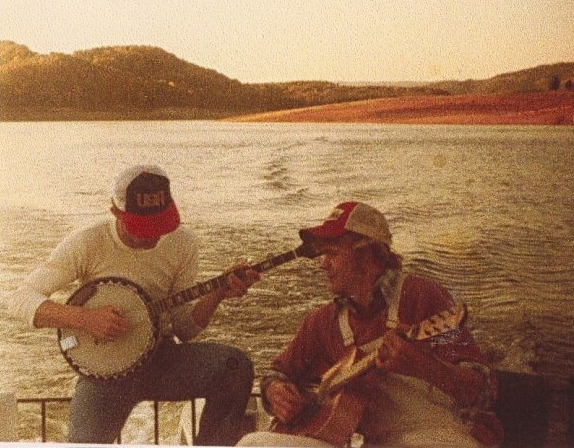 In my book, fishing and music go together like blue crabs and Old Bay seasoning. It’s hard for me to imagine one without the other. I’ve been singing, playing, and writing music for as long as I’ve been fishing. Here’s a shot of me with my best friend Curtis Seals from back around 1979 picking and grinning on the deck of the houseboat I called home. You can’t tell it, but Curtis is steering the outboard with his left foot while he picks his banjo. That takes talent!
Many of the songs I’ve penned relate to the water in one way or another. My songwriting has slowed in the past few years because, in my opinion, a good song needs a firm sense of place. After moving away from my home in the Appalachian Mountains to this Chesapeake Bay country, I needed to thoroughly steep myself in the culture before trying to translate local images into songs. A few verses have been showing up in my head lately though, and my old Martin D-18 guitar is coming off the stand a little more frequently than it used to. My son Daniel has a gift for immediately capturing the spirit of the places he visits. He recently turned out a chilling ballad about the ghost of a barge captain who haunts the waters around Cape Charles, Virginia. I’m excited about the song because it’s laced with images of hurricanes, lighthouses, oyster bars, diving gannets, and blitzing rockfish. I hope he’ll record it soon. Read More!
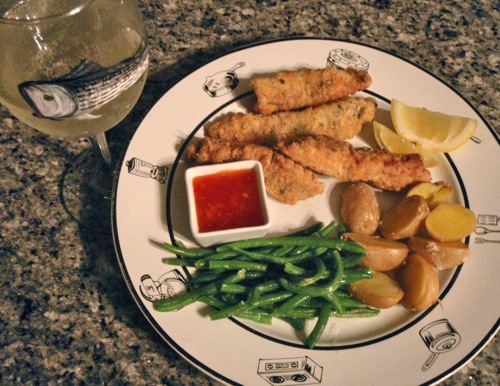 There aren’t many critters in Chesapeake country that are hated as much as cownose rays. Mention them around Bay fishermen and you’re sure to hear a few four-letter words. It’s probably because they steal a lot of lures. Some rays are so big and strong that many anglers simply cut their lines instead of trying to land them to get their equipment back. Then, there’s the knowledge that one painful slap from a ray’s long spiny tail can put you in the hospital, or that some people believe they can devastate a shellfish bar overnight with their powerful crushing jaws.
Yeah, most people hate them. So, it might seem a little odd that some organizations have started promoting them as a food source. In fact, the Virginia Marine Products Board is working hard to develop a commercial market for Chesapeake ray meat. From what I hear, it’s catching on. A grocery store in Hunt Valley, Maryland recently cooked some in the aisle and gave away free samples. They sold all they had on hand. When it comes to culinary trends, I’m somewhat adventurous, and since I generally like seafood and didn’t grow up with prejudices against rays, I’ve been thinking about bringing one home to see what all the fuss is about. My buddy Rich hooked a twenty-pounder just before dark last Wednesday evening, and fought it to the edge of the boat. Here’s how things turned out.
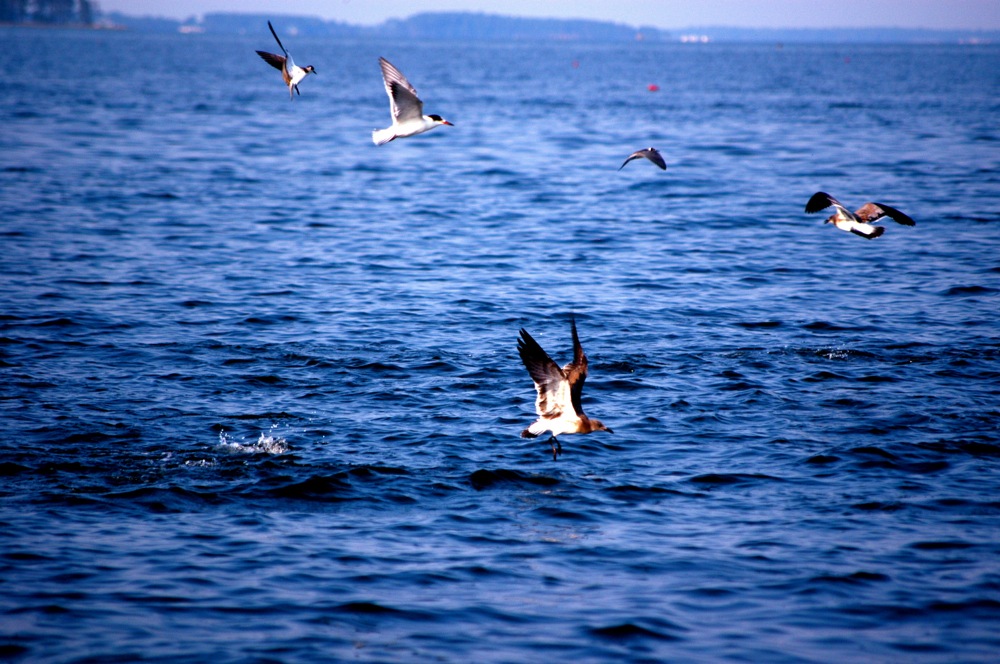 It’s summer and you live in the land of pleasant living. I hope you’re enjoying it. If your idea of fun is sitting in the hot sun, live-lining, soaking bait, or trolling, this entry isn’t for you. But if you like blasting through the spray on a fast boat, swerving around hairpin turns, and stopping on a dime to cast top-water plugs & jigs toward screaming birds over frenzied fish, you’re in the right place to enjoy some of the most exciting action the Bay has to offer. On an average summer day, a knowledgeable light tackle angler will catch more fish by accident than most bait fishermen can catch on purpose in a year. It’s time for running and gunning beneath working birds on the Chesapeake Bay. Summer breakers are here, and it’s your mission to find them. In an earlier segment, I wrote about how important it is to stay as close as possible to hard bottoms when looking for open-water summer fish. In this entry, I’ll say a little about looking for breakers including some strategies for fishing beneath working birds. I’ll also mention some individual species and cover what they might tell us about the fish. Read More!
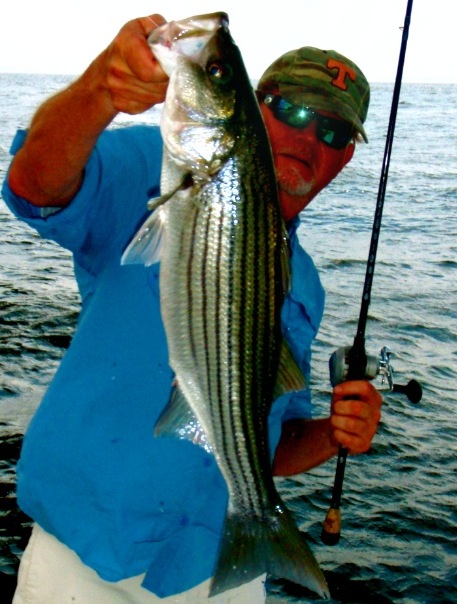 Okay, so this entry might be a little heavy on the fireworks and light on the rockfish. That’s because I’m not too good at fishing in crowds, so I spent most of last weekend doing chores around the house. That’s not to say I didn’t get some time in on the water. In fact, I don’t think I missed a day, but most of my time on Thunder Road was spent cruising to fireworks shows around Kent Island. Since this is a fishing website, I’ll start with a catching report. I met Rich at Sandy Point State Park Friday afternoon for a few minutes of piling picking onboard his 19′ Sea Hunt center console. There was very little wind but plenty of boat wakes, so we took our time getting to the our fishing spots. We had a ripping outgoing current so we rigged up soft plastic lures on three-quarter ounce jig heads. I was throwing a hotrodded white 6″ BKD and Rich had on some kind of chartreuse lure I didn’t recognize. I think we caught keeper size stripers on our first four casts, so we could have had a 5-minute limit. We stayed with it for two and a half hours and released 27 keepers with plenty of shorts. We caught on both the east and west sides of the bridge, even sneaking in downstream of some bored-looking live-liners who didn’t seem to share our amusement when we pulled nice fish right out from under the pilings where they were anchored. Read More!
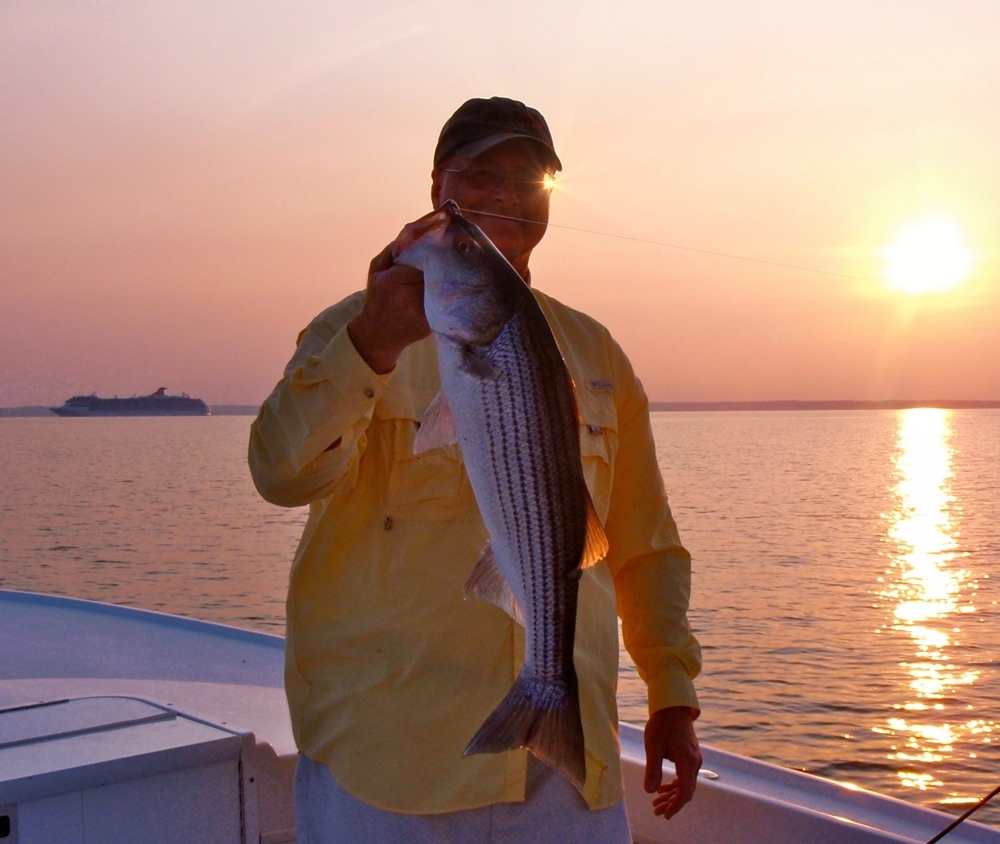 Channel catfish at Hackett’s Bar, carp at the Bay Bridge, snakeheads in St. Jerome’s Creek, and very few stripers in their usual haunts around Kent Island – what’s up with all this late-spring craziness in the Chesapeake Bay? Most fishermen are blaming salt, or more specifically, a lack thereof. Very wet weather in the Susquehanna River watershed has meant lots of fresh water entering the Bay. It’s highly unusual for the Bay to be this fresh in June. Some stations are reporting the lowest readings in recorded history. Salinity is expressed in parts per thousand (ppt), in other words, the number of grams of dissolved salts present in 1,000 grams of water. The water in the Atlantic Ocean is about 35 ppt. Surface salinity today at the Gooses Reef Buoy in the Mid-Chesapeake Bay is 2.0 ppt. That’s low! For better striped bass fishing, we need more salt.
Fishermen have long recognized the importance of locating comfort zones where fish prefer to stay, but sometimes that isn’t so easy. Fishing in late May and early June is usually a challenge, but low salinity levels have made it especially difficult this year. Complicating the matter is that he water can be a lot saltier on the bottom of the Bay than it is on top this time of year. Since, in addition to surface observations, The Gooses Reef Buoy also provides salinity readings from the bottom of the Bay, we can see that it’s currently 7.1 ppt. That’s over three times saltier than it is on the surface. Read More!
 At any given moment there are over 2000 thunderstorms going on around the world. Lately, it seems like most of those are rolling across the Chesapeake. I’ve had several opportunities to fish through the weekend and most of my short trips involved storm dodging. The fishing has been about as unstable as the weather. I’ve taken a couple of complete skunks, had some so-so trips, and finished the weekend with a very successful but somewhat precarious Sunday-evening excursion with Rich and Jamie. We haven’t found a bite in the Upper Bay yet, but the fishing is trying to turn on to the south and east of Kent Island. Most fish are feeding over humps and ledges in the 16-25 foot range, especially over hard oyster bottoms. There is also a decent top-water bite in the shallows at places where the current is visibly moving and fish can find quick access to deeper water. Perch and hard-heads are also lighting up the hard bottoms and can be caught with small metal jigs or scented soft plastic grubs. The water remains very stained. Skies are supposed to be unstable throughout this week. Full-moon currents are ripping so light tackle casting should be pretty good if we can dodge the lightning. Here’s a 2-minute photo montage of our thunder-laced trip Sunday evening trip.
Read More!
