Click the Book Covers Below to Buy the Books

Recommendations




sharps island
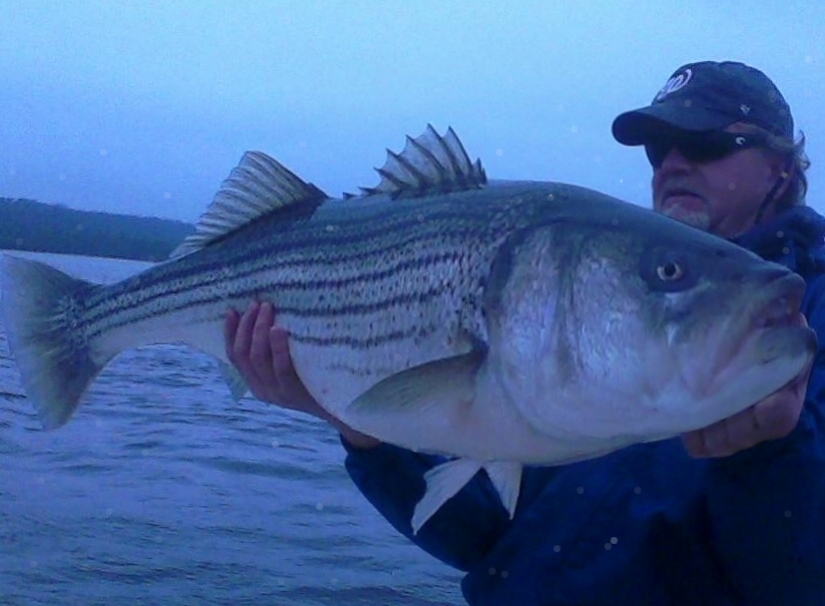 By all accounts, 2012 was an unusual year for fishing. For me, it was absolutely strange at times. I jigged up my biggest striper of the year on the first day of the year, a 49-incher that might have pushed 50-pounds. It was the only fish I caught. A few days later I got another 47-incher and another one about that size on the next day. Each time it was only one fish per day. Is one fish worth five hours or more of casting? When they’re that size, I think so! Those were some of my biggest fish of 2012, but I’ve been lucky enough to jig up a few more mid-40s class fish since then including this pretty 45-incher I caught in the snow this week. Warm water discharge (WWD) fishing was good last spring, but we really had to pick our days. Our most successful times were early-morning windy weekdays when it was raining or snowing. The WWD big fish bite is always very specific. I explain how to get the trophies in my book, Chesapeake Light Tackle, An Introduction to Light Tackle Fishing on the Chesapeake Bay. Read More!
 “There are no more deserts. There are no more islands. Yet there is a need for them. In order to understand the world, one has to turn away from it on occasion; in order to serve men better, one has to hold them at a distance for a time. But where can one find the solitude necessary to vigor, the deep breath in which the mind collects itself and courage gauges its strength? There remain big cities.” -ALBERT CAMUS from THE MINOTAUR.
I must apologize for the lack of fishing reports lately. I’ve required some time to concentrate on other interests, dance for a while to the songs in my head, and step back to reassess some priorities after over-extending a little. I’m currently writing from a boat off the Florida Keys. I’ve been here for the past ten days or so. It’s been relaxing, rejuvenating actually, and I’ve enjoyed some successful fishing. My time for tuning out is about over, so next week I’ll be back working in the big city, and perhaps more importantly, back in the swing of the Chesapeake fishing scene. On August 20th I’ll speak to the Broadneck/Magothy MSSA chapter about Strike Triggers and Catch & Release techniques. The following night, August 21st, I’ll travel to the Essex/Middle River chapter to present a similar talk. On August 25th and 26th I’ll have a book-signing table and also give a couple of talks at the 6th Annual Maryland Buck Wild Outdoors Expo. Look for me all day Saturday and Sunday. Read More!
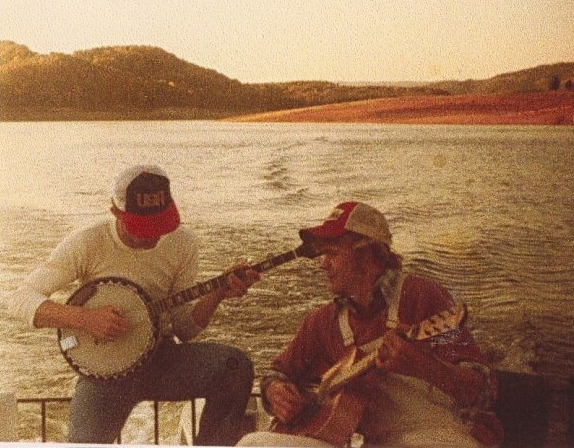 In my book, fishing and music go together like blue crabs and Old Bay seasoning. It’s hard for me to imagine one without the other. I’ve been singing, playing, and writing music for as long as I’ve been fishing. Here’s a shot of me with my best friend Curtis Seals from back around 1979 picking and grinning on the deck of the houseboat I called home. You can’t tell it, but Curtis is steering the outboard with his left foot while he picks his banjo. That takes talent!
Many of the songs I’ve penned relate to the water in one way or another. My songwriting has slowed in the past few years because, in my opinion, a good song needs a firm sense of place. After moving away from my home in the Appalachian Mountains to this Chesapeake Bay country, I needed to thoroughly steep myself in the culture before trying to translate local images into songs. A few verses have been showing up in my head lately though, and my old Martin D-18 guitar is coming off the stand a little more frequently than it used to. My son Daniel has a gift for immediately capturing the spirit of the places he visits. He recently turned out a chilling ballad about the ghost of a barge captain who haunts the waters around Cape Charles, Virginia. I’m excited about the song because it’s laced with images of hurricanes, lighthouses, oyster bars, diving gannets, and blitzing rockfish. I hope he’ll record it soon. Read More!
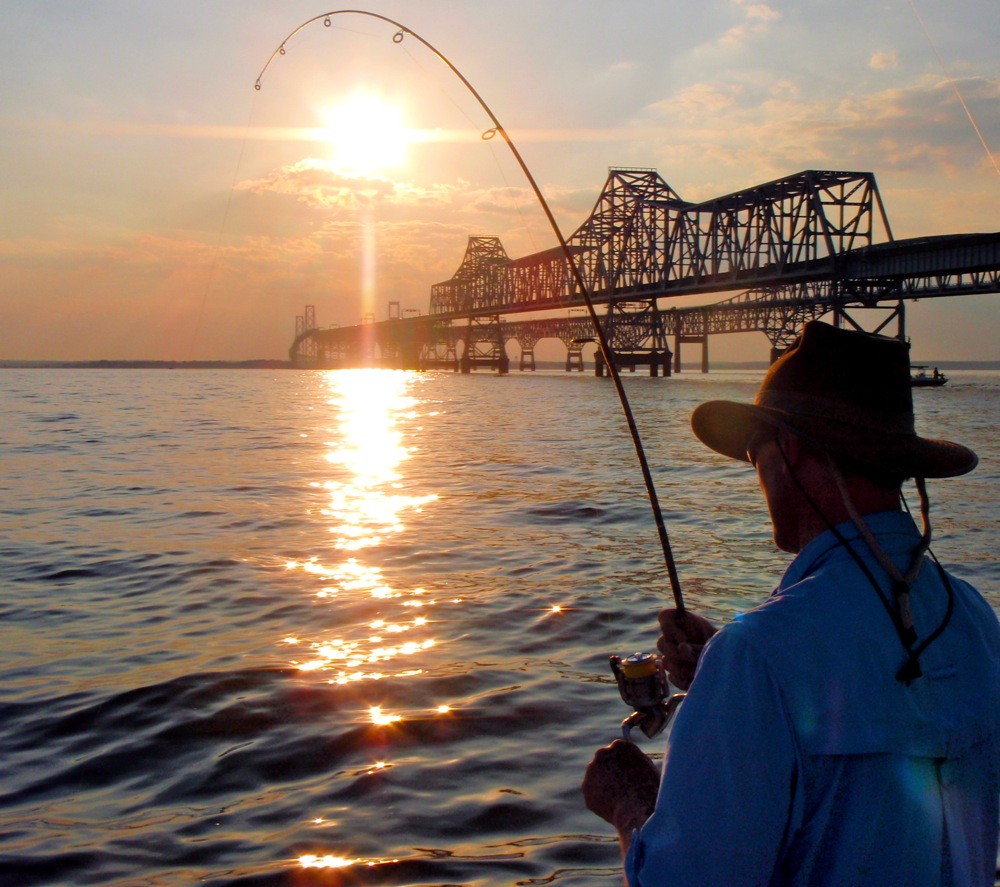 Mmm, July on Kent Island: when the water is savory and smooth and salted with all manner of boats, when tourists flock to the Eastern Shore beaches and bridge traffic backs up for miles while drivers peek over the rail for a glimpse of the sparkling spectacle that is summertime on the Chesapeake Bay. Summer can be both sweet and sour to Chesapeake fishermen. Sometimes we wonder if it’s worth trying to fish in this Hell’s Kitchen of boats, everyone jockeying for the single best position from which to make the sweetest cast. But fish we must, so we line up like line cooks to join the fray, vowing to stay even-tempered when inevitable conflicts arise and deluding ourselves that, when we get there, we’ll have that delicious “top-secret” spot all to ourselves. Mmm, mmm, summertime, sweet summertime. Read More!
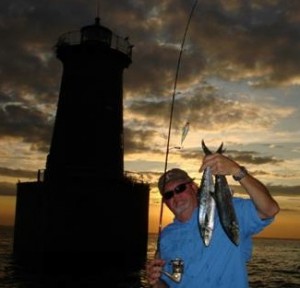 While I haven’t seen any Spanish mackerel flying around the Eastern Bay recently, I was fortunate enough to find a school farther south tonight. I fished onboard Fishadler II with Mark, launching out of Queen Anne Marina on Kent Island. It’s a full moon which usually means increased current, but we haven’t had much incoming tide this week. Fortunately, the outgoing current has been very strong. About 3:00 PM – during the last hour of the outgoing – we found breakers near Sharp’s Island Light and noticed macs in the mix. That’s about seven miles south of where they were last week. Although we had trolling gear on the boat, it looked like there might be enough to catch some casting. I started slinging a homemade three-quarter-ounce inline sinker, flattened and rolled in super-fine blue glitter with a treble hook attached. I think I hooked six or eight macs, but didn’t get them all in the boat. Casting for macs is a different game than trolling for them. Even if you can find them and manage to hook one, getting them to the boat is very challenging. The trick is to keep their nose pointed toward the boat, then sling them up over the side. If they ever turn and head off in the opposite direction, they’re usually gone. Read More!
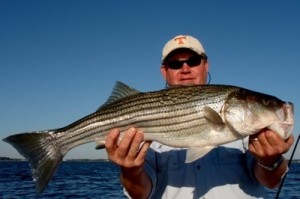 Memorial Day Weekend marks the start of summer for many Chesapeake boaters, but it means a slow-down in fishing for those of us who have been out all along. All the boat traffic on the Bay can put the fish in hiding, but it’s a tough time of year no matter what. Many anglers blame the slow fishing on may worms. May worms, also called clam worms, live on the shell bottoms of the bay and swarm during late May. The reddish worms can be up to 5 inches long and develop small swimming fins to propel them up from the bottom when they mate during the dark of the moon. I guess they are a tasty treat for rockfish. Some fish you catch this time of year area actually yellow or red tinged because of all the may worm gorging. Read More!
